
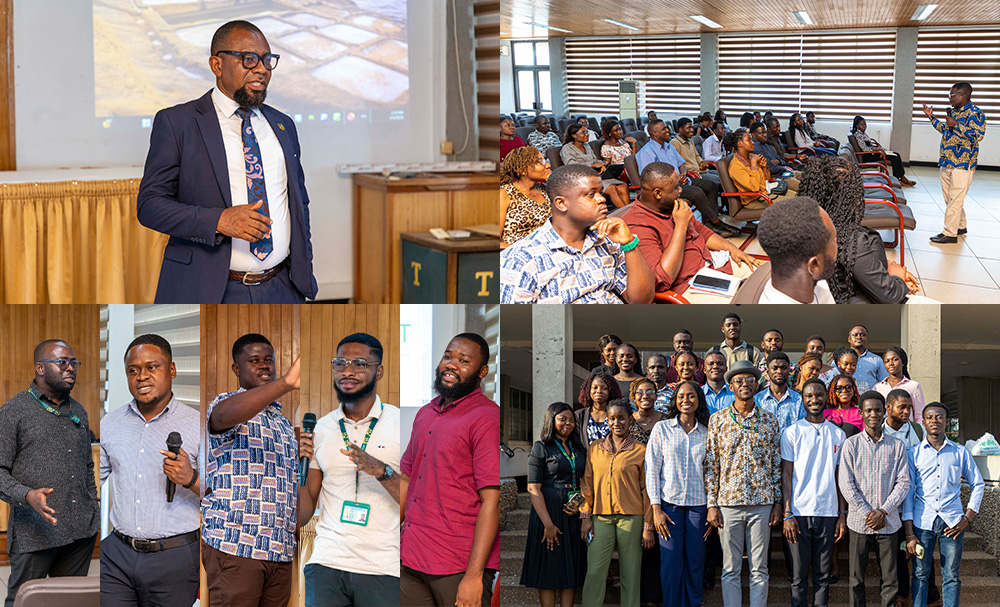
The University Relations Office (URO) of the Kwame Nkrumah University of Science and Technology Kumasi, (KNUST) has organised a capacity-building workshop for web administrators across the University to strengthen digital content creation, institutional branding, and online visibility.
The workshop brought together web administrators from various colleges and units of the University and focused on practical skills in news writing, content development, institutional branding, and photography for web and social media platforms. The sessions were facilitated by experienced personnel from the University Relations Office and related academic departments.
Delivering a presentation on news writing, Dr. Daniel Nkrumah, a Lecturer at the Department of Language and Communication Sciences, underscored the importance of accuracy, clarity, and attribution in institutional reporting. He emphasized the correct use of verb tense, active voice, and proper sourcing of statements to avoid misleading readers.
“If you say, ‘Ghana on the path of economic recovery’, and you don’t attribute it, people will say you are claiming it,” he explained, stressing that un-attributed assertions can undermine credibility. He further advised that adjectives in headlines should be placed in single quotation marks when they reflect opinions rather than verified facts, while double quotation marks should be reserved for quoted speech in the body of news stories.
Another facilitator, Mr. Emmanuel Kwasi Debrah, Head of Media and Events at the URO, encouraged participants to clearly define the focus and angle of their stories in line with their unit’s mandate and institutional identity.
He explained that every report presents a choice between highlighting the event itself or the individuals speaking at the event, and that this decision ultimately shapes the narrative.
“Where are you going to take your story from? Is it the event or the people speaking? It is up to you,” he noted. He also reminded participants that content does not always present itself naturally, making proactive news gathering an essential responsibility for web administrators.
Beyond writing, participants were also trained in institutional branding and photography for effective web communication.
Speaking on branding, the Assistant Registrar in charge of Publication and Documentation, Mr. Isaac Marfo, described branding as a strategic process rather than a decorative exercise. According to him, branding shapes the University’s identity, reputation, and public perception.
He highlighted clarity, consistency, and constancy as the three core pillars of strong institutional branding, stressing that these elements are crucial for building trust and recognisability across digital platforms.
In a session on institutional photography, the Principal Technician at the URO, Mr. Jonathan Gyepi-Attee, emphasised the need for photographers to be alert, proactive, and unobtrusive during events.
He explained that institutional photographers must anticipate movements, position themselves strategically, and capture symbolic moments such as greetings and transitions without disrupting proceedings.
“Movements are timed, and so must you be, because missed moments cannot be repeated,” he said, urging photographers to arrive early, prepare mentally, and think ahead.
Addressing photography for university websites, Mr. Emmanuel Offei, a Senior Technician, advised that effective web images should be sharp, well-lit, visually balanced, and authentic to the University’s activities.
He encouraged the use of official images, appropriate file-size optimisation for faster page loading, and proper acknowledgement of photographers where required.
“A good website photo should be clear, properly framed, and maintain a professional tone,” he noted, adding that high-quality images create positive first impressions, build credibility, and communicate the University’s story, culture, and impact.
The workshop concluded with a call for closer collaboration between web administrators and the University’s media and photography teams to sustain high standards in institutional communication and enhance KNUST’s digital presence.


